

info@heliosfoundation.be
Tel. (+32) (0)471 25 36 88
Partner
Lead
Duration
Funded by
Why this matters
About the project
Noak (short for “new of a kind”) was founded in September 2025 as a spin-off of imec and UHasselt. It builds on more than ten years of research into perovskite-silicon tandem technology within IUMAT, the Institute for Materials Research of UHasselt and imec, and at EnergyVille in Genk, where the company is based. The intellectual property developed there has been transferred into Noak, which will now develop, validate and industrialise the technology. Noak-PV is also one of the ten projects selected in the Helios Foundation’s Decarbonisation Challenge, in which it will validate pilot-line production of its tandem panels and demonstrate their readiness for multi-gigawatt scaling.
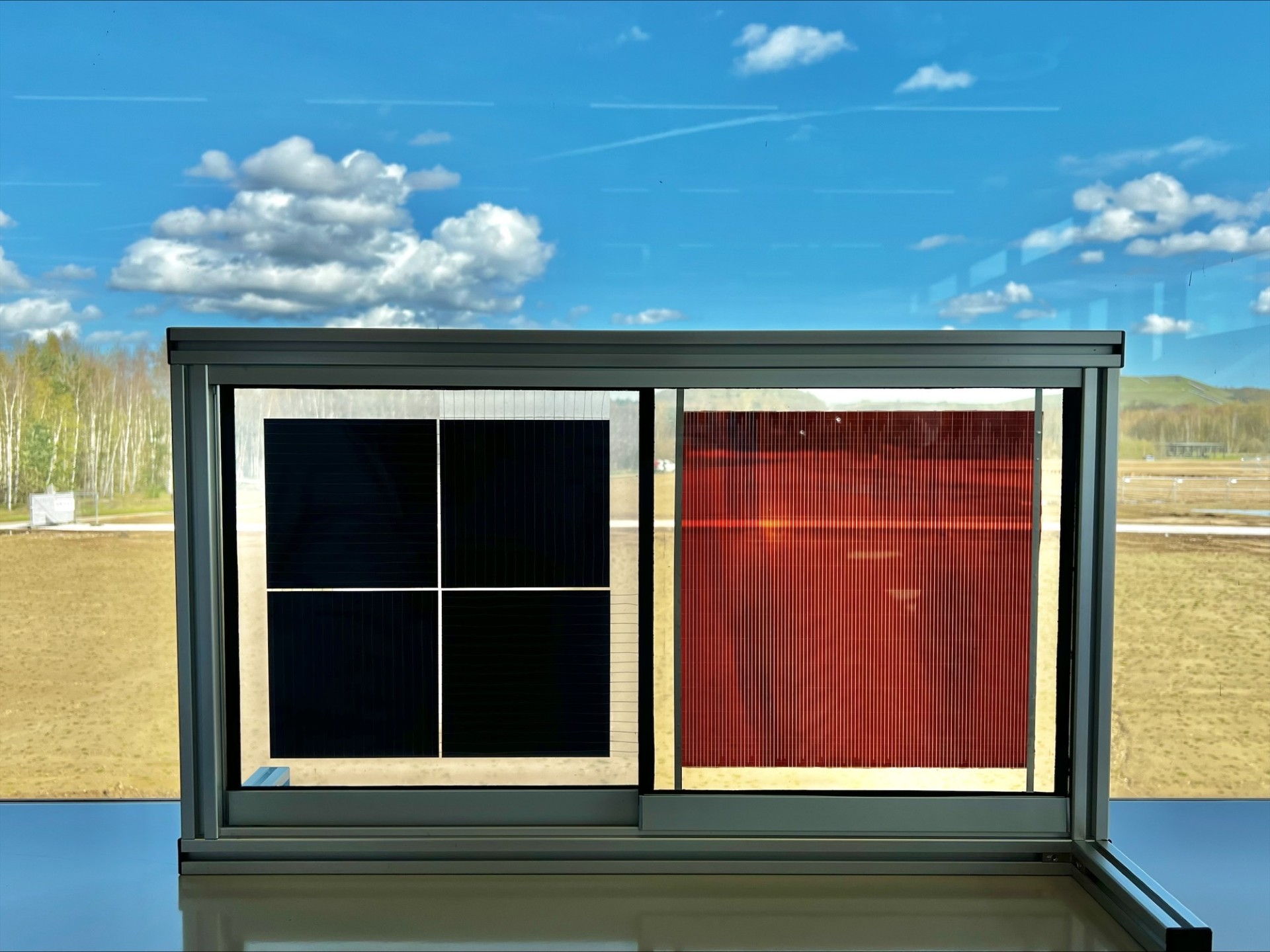
The technology. A tandem cell places a very thin layer of perovskite crystals on top of a conventional silicon cell. Each layer captures a different part of the solar spectrum, so more of the incoming sunlight is turned into electricity. Noak targets efficiencies of 30 to 35%, compared with roughly 20 to 25% for many panels on the market today.
Tested outdoors. Long-term stability is the main challenge for perovskite technology, which is sensitive to moisture, light and heat. The imec and UHasselt cells have been tested outdoors for five years at 11 sites in Asia, Europe and North America, through intense sun, extreme heat, heavy rain and sub-zero temperatures. That dataset is the basis for demonstrating commercial viability. Stability at industrial scale still has to be validated in the next phase.
Fewer scarce materials. Noak has developed its own 3D-woven foil that integrates the electrical connections at the back of the cell. This means less metal on the front, so less sunlight is blocked. Together, the cell design and the foil sharply reduce the use of expensive and scarce metals. The cells can also be cut into smaller cells and connected in different ways, which allows several module designs. Circularity is built in from the start: components are designed to be separated and recycled at the end of their life, and Noak aims using 100% recycled metals.
From lab to factory. Noak will first develop the technology further and validate it with its first customers, using the existing EnergyVille infrastructure in Genk. The next step is an industrial pilot line, planned around 2028, followed from 2030 by gigawatt-scale production together with industrial partners. One model under consideration: established manufacturers outside Europe supply unfinished silicon cells at scale, and part of the production process takes place in Europe. Noak is exploring partnerships in countries such as .
The team. CEO Geert Palmers co-founded the energy company 3E and led it for about twenty years. He began his career at imec, researching efficient solar cells. He is joined by Chief Technology Officer Michele De Bastiani, a materials scientist who set records with high-performance tandem cells at the Swiss research centre CSEM; Chief Manufacturing Officer Wouter Ooghe, who helped start up gigawatt factories in Southeast Asia; Chief Financial Officer Stefaan Quinart; and Bart Boesmans, senior advisor for business development and former CTO of ACWA Power. An advisory board with experience in industry, investment and research supports the team, including imec fellow Jef Poortmans and KAUST professor Stefaan De Wolf.
Current status of the project
A timeline of the project developments
Expected impact
Climate
More renewable electricity from the same roof or land area. Tandem panels could deliver up to 50 to 75% more electricity from the same roof, and need around a third less land for the same capacity in large solar parks.
Materials
Less use of expensive and scarce metals, with Noak working towards near-zero silver in module interconnections, and components designed for separation and recycling.
Industry
Belgian research turned into a new company, with European know-how in solar cell technology developed within a more diversified international value chain.
Technology
A tandem technology tested for years in real climate conditions, brought from research to industrial scale.
Related projects
Links
